
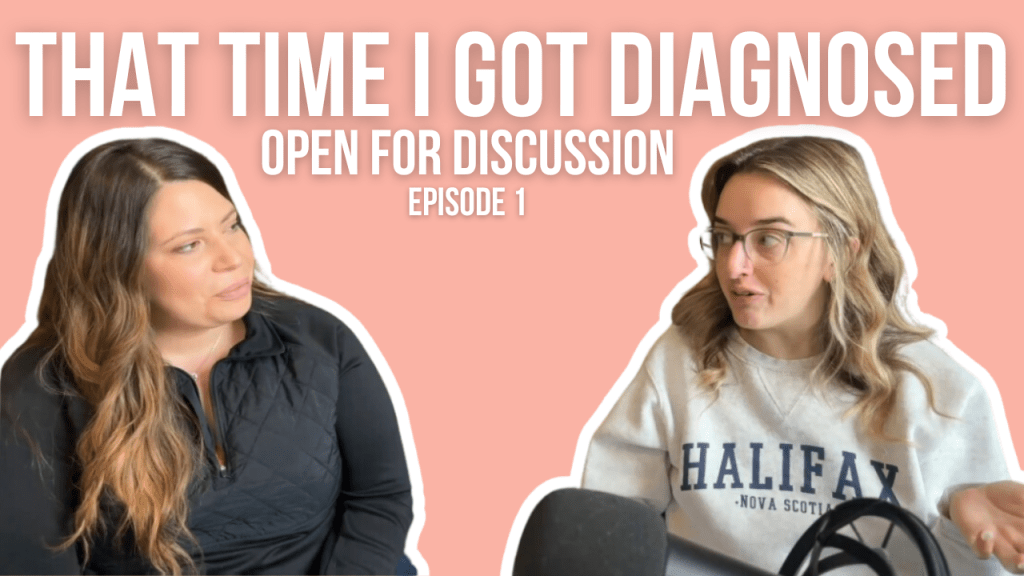
Candice: Hi! I’m Candice!
Emilee: I’m Emilee, and this is…
Both: Open for Discussion. [laughter]
Candice: We did pretty good with that. Pretty good.
Emilee: Today’s episode? Neurodivergence and how it affects parenting, the ways that we manage (or not).
Candice: I like to think of it these that are–how we set up for success.
Emilee: Yeah, okay.
Candice: So I’d like–maybe I’m too positive, I’m Positive Patty over here.
Emilee: it’s okay, I’m Debbie Downer, so we just balance each other.
Candice: We’ll balance each other out!
Emilee: First of all, how does one even find out that you have ADD, other than watching TikToks and self-diagnosing? [laughter]
Candice: Um, I got diagnosed about 2022, November, and then I was on medication a non-stimulant. I don’t know. I should know this stuff, but like, I’m on medication for it. Then got pregnant and then was off of it for, I’d say–let’s say roughly about a year, because I just got on it, probably January, but I’m back on and I feel better. Yeah. So how about you?
Emilee: I got diagnosed in 2020, so I was 29, and it was during lockdown. I was in the middle of a PhD program which, like, you’ve heard this story, but I stopped being able to read and I went to my psychiatrist and my psychiatrist was like “have you ever been tested for ADD?” and I was like “No” And she was like “okay, well, let’s let’s get you tested just to kind of be sure.”
Candice: Right.
Emilee: So she sent me this test. I took it, and then she scheduled the followup meeting and she was like “are you sure you’ve never been tested before?” and I was like “yeah, no I’ve not had a reason to be, I mean like I got all A’s in school, like I wasn’t hyperactive, so why would they test me for it?” and she was like “well you scored really low” and I was like
Candice: (“like thanks?”)
Emilee: “thank you?”
Candice: (“Is that good, right?”)
Emilee: “Thank you?” Um, she was like “Yeah, no, you have it and you have it bad.” And I was like “sweet, okay.”
Candice: um so may I ask, do you have ADD or ADHD?
Emilee: So, okay, she said ADD and then my paperwork says ADHD. I have done a little bit of research on this in the interim and everyone who has ADD is technically diagnosed with ADHD, like that’s the official diagnosis. But there’s three different types of ADHD: there’s hyperactive, inattentive, and combination.
Candice: Okay.
Emilee: So I have inattentive, which basically amounts to ADD, because I don’t have the hyperactivity part of it. I think that ADHD manifests that way in women and AFAB people, and that’s why it’s so underdiagnosed in us. Because everyone’s looking for hyperactivity and that’s how it manifests in boys more often, is that hyperactivity.
Candice: We were taught to be quiet and kind of like stay still and boys were more like, “oh it’s okay, go jump in the mud.”
Emilee: And “oh, boys are so active, boys have to get out their energy,” so boys were allowed to be hyperactive.
Candice: Yeah, that does make a lot of sense. Like I said I learned–I learned all of that from you today. Learned something new. It’s still a new realm for me so trying to figure that out–thoughts and processing–so like for me today it was like, I have to clean the kitchen, and I have to feed the baby, but I also really want coffee, and then my husband’s listening to some podcast in the background, but I was so overstimulated by the sound of his podcast, and–I think it’s just honestly what he’s listening to, I don’t know. And it’s nothing bad, a lot of it mostly, most of the time I’d find funny, but I’m just like turn it off.
Emilee: Just like so much–so many sensory inputs and you–your brain just like simply can’t handle that much input.
Candice: So what do you–do you talk yourself through that? Like what do you do?
Emilee: I mean I turn stuff off like, including if my husband is listening to something. Like he understands at this point that if I’m over stimulated I am going to turn things off. Like he–the other night we were, he was in the kitchen, cleaning the kitchen he was playing like music on the Echo. And we just got a record player and it’s in the living room and so stuff was playing on the Echo, there was a record playing on the record machine–the record player–the kids were making noise, and the TV was on. And there was just, like, so much going on and I was just trying to read my book, all I wanted to do was read my book
Candice: –do one thing–
Emilee: and I had been, like, I had been away from my kids all day. I didn’t want to go upstairs and isolate myself, although that can be a solution, but I didn’t want to, like, take myself away from the situation. I wanted to be there and I wanted to be in the room with my kids, but I couldn’t handle everything that was happening. So nobody was watching the TV, so I turned off the TV, and then Elliott was walking out of the kitchen and I–as he was walking out of the kitchen I was turning off the record player, he was like “Oh,” I was like “no, I’m really over stimulated” and he was like “oh, okay.” Like he gets it.
Candice: I love that.
Emilee: Honestly, if he’s playing something and I’m over stimulated it is totally like not a problem for me to just be like “can you turn that off”
Candice: Yeah I do definitely talk to, um, my husband about that. Like “oh you know what? I’m going to let you watch your YouTube, I’m going to go in the other room, read, or just like have some quiet time” and he’s like “okay,” because I don’t want to stop him from doing from listening to things. Because he’s the type of person where he can have all the things on, and I’m like “No no no, can’t, can’t do that.” But that’s me, so I don’t want to take from him to help make me feel better.
Emilee: I get that, but I also feel like, he has his commute to listen to whatever he wants. That’s fair. So he can catch up during his commute and I can ask nicely to please shut that s*** off. Shut it off.
Candice: I will say, um, when Isaiah listens to stuff he has these really nice ear buds that he also got me, and so like if you’re talking to me and I still have something on I’m like “what?” and it’ll actually pause whatever I’m listening to so I can hear you. Or if I’m at the store and just like, if I’m listening to a podcast or something, I can still hear enough around me so it doesn’t completely just like dull everything.
Emilee: So I have these, actually I didn’t even think about this, but I have them sitting right here, they’re Loops.
Candice: Yes! I keep seeing the advertisement!
Emilee: Like earplugs and I have two different kinds. I have the ones that are actually like the the Loops.
Candice: Yeah the Loops, yeah.
Emilee: Um, that are silicone and then I think my other pair is like a plastic um, noise cancellation, and these have been really great. These are grocery store ones for sure. When I get when I go to the grocery store I know I’m going to get overwhelmed because florescent lighting, there’s too many people, even if it’s like not that many people there’s too many people, I it’s so much sensory input and information coming in, cuz there’s like words and brands
Candice: (“words and brands!”)
Emilee: just being inundated with information all the time. When I go to the grocery store I have to wear my earplugs and I have to wear a hat so that I can, like.
Candice: You’re just focusing on–yeah no I totally understand. And like,
I don’t know if you’ve seen those horses, like when you go for a trolley ride or anything like that–trolley–
Emilee: Oh, the blinders?
Candice: Yeah the blinders! It keeps them focused on what they’re–yes–and I’m just like I need those.
Emilee: Yes! Well, that’s what this is.
Candice: Yeah, that’s honestly what it cuz I have to sit here and process on or figure out how I’m going to do this. Do you do that?
Emilee: Every person with ADHD does that.
Candice: Oh, okay. So I’m not alone.
Emilee: No you’re not alone. I actually had this conversation multiple times–okay–I saw I saw it on Tik Tok first!
Candice: I know!
Emilee: This, this guy I was like “did you know that neurotypical people, when they do their habits, they don’t think about them? It’s a habit because they don’t think about them. They wake up, they go to the bathroom, they brush their teeth.” Yeah. They don’t think about the steps that it’s taking, like, as they’re doing it, it’s literally habit and I was like “No. No way, no.” Because when I wake up I lay in bed and I’m like “oh my God I have to get myself out of bed, you have to get out of bed, Emilee get out of bed. First I’m going to swing my legs around the side of the bed and then I’m going to sit up,” I’m like micro steps, otherwise I will lay in bed all day. Stand up and then I’m like” have to brush my teeth, time to brush your teeth, we’re going to go in there, we’re going to take our aligners out, and then we’re going to put the toothpaste on the toothbrush,” like I have to walk myself through every step. Neurotypical people don’t do that, it just happens for them without thinking, and when I first heard this I was like that cannot be true.
Candice: But it’s true!
Emilee: It is true. So then my mom was over and I was like, “hey Mom, did you know that there are people whose brains do this and like they don’t have to think through every single thing that they do?” and she was like “Nah.” and I was like “oh honey you need to go get tested.”
Candice: You oh honey’d your mom!
Emilee: “You need to go get tested for ADHD,” and as it turns out my mother has ADHD.
Candice: I just feel like as soon as a female is out in the world it’s just, here slap this on them, you have this.
Emilee: Okay, I have felt like that.
Candice: Yeah.
Emilee: I have felt like there’s just like this glut of diagnoses, like everyone’s getting diagnosed. If you look at like, the percentage of boys that are diagnosed with ADHD, it’s actually pretty comparable to the number of women that are getting diagnosed with ADHD now. It’s just that women were underdiagnosed when we were young, we didn’t get the attention and the help that we needed when we were young, so we’re getting it now.
Candice: Let’s just suffer until we’re in our 30s.
Emilee: Yeah. But we’re getting the help that we need.
Candice: We are, and that’s also why we have this podcast, so we can talk about stuff and just know that we’re not alone. I’m learning I’m not alone. There was like, speaking of TikTok, I recently saw, and I wish I could remember the creator, they were basically saying like “oh if you have something to do at 3:00 you start your day as to when you’re going to wake up, how long it’s going to take you to get ready, what you have to do to get out the door, how long traffic is going to be to get there, to be there at this time” and so basically, the first part of your day is getting to this event, that’s in basically the middle of the day or even a little bit towards the end of the the afternoon.
Emilee: You lose the whole.
Candice: You lose the whole day.
Emilee: It’s called waiting mode.
Candice: Is that what that’s called?
Emilee: Yes and my–the way that waiting mode manifests in me is if I have an appointment, let’s say at 1 p.m. I know I need to like start getting my hair done and get everything like done at like 11:45 or 12. I don’t take super long, but I will need to shower way ahead of that because I need to factor in time to sit in my towel on my bed on my phone for like an hour, because that’s what I have to do after I get out of the shower. The transition moment between the shower and getting out of the shower is, like, so much for me, that I need to, like, dissociate after I do that.
Candice: Or maybe it’s more for you, like, I’m going to take mindless scrolling time, and that’s not a negative thing at all, but just this is my fixed, like I’m focusing on this and this is my moment to just have Emilee time.
Emilee: Yes, I mean that’s probably some of it. So the way that I’ve kind of gotten around this, and losing a whole day to appointments, is booking appointments as early in the morning as I can.
Candice: (Smart!)
Emilee: It’s like the first thing I do in the day, I’m not losing the whole day. Also once the appointment is over, I feel like, well there’s a big box checked off, like that is giving me momentum to do more stuff during the day because I did this big thing. Like oh, I went to the dentist? Wow. That was a huge accomplishment.
Candice: Yeah, cuz you did this thing and now it’s like, now I have the rest of the day.
Emilee: What else can I do? Write a blog post, I’m going to go, you know, I’m going to go write a chapter of my book, like I’m on a roll already. And it’s 9:30 in the morning.
Candice: That’s a good idea. What else do you do to to cope, to set yourself up for success?
Emilee: I have to trick myself. I have like I have to scam myself into actually being productive. My, well, my biggest, probably–I don’t know if downfall is the right word? Or like the thing that I get sucked into is, I will plan. I’ll set up like a calendar for myself and I will take 2 hours to set up the calendar and the routine and the schedule for myself, and then when it comes time to actually do it I’m like meh.
Candice: But so, you’re planning as that Emilee and that time period, not future Emilee. And the needs and knowing how you’re going to be later on.
Emilee: Yes. So something I’ve been working on is not letting myself fall for the planning trap.
Candice: That’s actually a really good point cuz I tend to do the same thing and then when the morning comes up I’m like, yeahhhh.
Emilee: Like I told myself yesterday that I was going to get up at 6:00. I was going to do yoga, I was going to make myself a halfway decent breakfast because I’ve really been slacking on the breakfast front, and then that way I would have time to, like, calmly move through my morning.
Candice: Mhm.
Emilee: I woke up at 8:00 and Ellie has to be to school at 8:30.
Candice: Who else can relate to that like cuz I feel like that’s yeah, that’s a normal, yeah.
Emilee: And my alarm went off! Do I remember my alarm going off? No. I remember Elliott rolling over and being like, “hey what time does Ellie have to be to school?” me looking at my phone and I’m like s***. Yeah. Looking for and open to advice on all fronts when it comes to this.
Candice: I actually was listening to a podcast this morning about setting up goals that you can achieve. So her thing is, take one week, and she was applying this to, like, eating habits, exercising, like more like um, fitness. But I feel like this can be put across the board. She was saying take one thing, and that one thing you do every single day for one week, so seven days straight, and then the next week add on the next new thing because the first week you’ve already done, so already mastered that, so if your thing is a good breakfast in the morning, either plan that ahead, or whatever it is. Yeah. And do that every single day, and I’ve done some of that. Now mind you having a six-month-old, everything is chaotic and everything’s everywhere. However, a cup of coffee in the morning before I do anything for anybody else is always something, is for me. Yes. So I do stick by that because I do feel like that is something you can do. I don’t know, I would say like find something that’s like small enough and tangible enough. Yeah. To do for one week and see if you can do it.
Emilee: Yeah. I think for me the issue is I’ll be able to do it for that one week.
Candice: But then to do it again?
Emilee: And then I’ll be able to like– I’ll be able to do it for maybe like, four weeks, five weeks, and then suddenly if I lose one day, if I miss one day, I’m like well that’s it. It’s done. I can’t–I can’t do it again.
Candice: Okay.
Emilee: And I’m trying, working on that as well, and I know that that’s not just me, I know so people struggle with that. Because I have a friend who was journaling for a while, felt good about it, it was doing a lot of good for them, and then they missed a day and they were like, well, yeah I can never journal again.
Candice: Or like you feel like you have to start on a Sunday or a Monday? The beginning of the week.
Emilee: Yes! You don’t have to.
Candice: The beginning of the month, or.
Emilee: But I understand that. It’s like the Fresh Start Fallacy.
Candice: Anytime can be a fresh start but then trying to manipulate that in your own head–like not manipulate, but I kind of feel like I have to manipulate myself.
Emilee: Absolutely, I said I have to scam myself!
Candice: We’re both such, you know, supporters of our indiv–self.
Emilee: But this extends even to like medication for ADHD. Like, I’m still in the middle of my own medication drama. So I am on Focalin for my ADHD.
Candice: Okay.
Emilee: And it’s one of the ones that’s affected by the shortage so my pharmacy is always out of it and my prescription is only good for 30 days.
Candice: So you have to get a new one.
Emilee: So I have to, they don’t have Focalin in stock over the course of 30 days, I have to call my psychiatrist and have them send over a new prescription in order to like have my prescription on file at the pharmacy. I have ADHD. Do you think I’m going to remember to call every 30 days?! No!
Candice: So is there, can you not ask your psychiatrist to be like, hey can you make this like a month…
Emilee: No, because it’s like a controlled substance. There’s so many rules around it.
Candice: And your psychiatrist can’t put it in?
Emilee: NOPE.
Candice: Every 30 days?
Emilee: Because I’m supposed to have a check-in appointment every 30 days, to make sure that the medication is still doing what it needs to be doing, so that she can check and make sure I’m not misusing the medication, like it’s like this whole thing. And meanwhile I, a person who cannot stay on top of things because I have ADHD, like I am not managing this at all. I–
Candice: You know what, no. I think you are. Because you have two children, a whole household.
Emilee: True.
Candice: You keep everybody alive, and of course your, your husband as well, your partner, yeah um, you two work, from my seeing, you both are doing very well, um, you know, balancing each other, having open communication, your kids are delightful. They’re, I mean, I love your kids. I think they’re great. You’re a lovely person, you have the best animals, so even though like, I don’t think you should say like, “I’m just like, no, it just doesn’t work.” I’m like no you do, for the important things.
Emilee: Yeah.
Candice: So when it comes to yourself, you do not–and I feel like that’s somewhere where you and I both definitely connect on that, because it takes a lot for me to remember to do–oh yeah, I should probably eat something.
Emilee: Yeah like my own self falls through the cracks.
Candice: Yes.
Emilee: Because my other medications, like my medications for depression and anxiety, granted those are not in a shortage right now, so it’s a little bit different, but I have no–well I wouldn’t say no problem–I have fewer problems keeping up with those than I do with my ADHD meds, it’s just that like the circumstances around it right now combined with the fact that I’m not currently medicated for my ADHD.
Candice: Yeah.
Emilee: It’s like a vicious cycle. If I–maybe if I were being actively medicated for my ADHD, I wouldn’t have such a problem calling every 30 days–but if I had my ADHD meds, then I wouldn’t need to be calling every 30–you know, it’s the vicious cyle!
Candice: I get that, I do. So what do you do to help remind you of this?
Emilee: Oh gosh.
Candice: How do you–do you set yourself up for success, Emilee?
Emilee: Post-its on my desk is a big thing, um, I have my planner,
Candice: Are you a planner girl?
Emilee: I’m a planner girl.
Candice: Okay.
Emilee: And I have like– and I’m also like, I’m like a multiple-calendar girl, like I have, like, multiple paper calendars going for different things. Like I have my content calendar, I have my calendar for the kids and like their activities and stuff, and I have my planner which has, like, my day to-day stuff in it. Um, I’m also a big Notion girlie.
Candice: Yeah, I’m still learning. I love the idea of it, but.
Emilee: Love Notion. Notion sponsor me. I’m a big I’m a big notion girlie. Um, and that has actually been really good, because you’re able to create, like, checklists and databases and like calendars all in the same thing. Um, it is visually appealing to me, which is necessary as a person with ADHD, like I find if it’s ugly I’m not going to use it. Like it has to visually, aesthetically make sense.
Candice: I didn’t know that that was an ADD thing, or neurodivergent thing, I’m just–I thought that was like a Libra thing or something.
Emilee: No! There are people who walk into a store and just pick the first planner off the shelf and they’re like, “I’ll just use this one, I don’t care what it looks like.” Me, I’m in that planner aisle for like an hour. I am looking through every single planner, I’m like, comparing all of the attributes of the planners, I’m in there for an hour.
Candice: I really just like stickers.
Emilee: Yeah.
Candice: When it has like, all the achievement, check-off, I’m like well now I’m doing too many things.
Emilee: I need, it depends. But it’s like, you and I have very specific preferences about what our planners look like. There are people who literally just walk into Target, go to the planner aisle, grab a planner, and walk away. They’re like this will work, I’m sure.
Candice: So we were talking about um, ways to set up for success, and I just learned about Trello.
Emilee: Yes.
Candice: Um, because, Notion, I’m I swear I’m smart, I am, I’m very intelligent, but trying to–that is just too much for my brain.
Emilee: Notion, it’s really not an intelligence thing, it’s a learning curve thing, and it is because it’s so much database building, and because you have you’re doing all the backend stuff, you’re building the database from scratch. And um, but on Trello you’re only–you only see the front end of that, and you don’t have to build that database from scratch, all that other stuff is going on in the background. It’s just–it makes sense to me in my brain.
Candice: I’m sitting here looking at it two ways, like, I’m like, oh my gosh, this looks so great, I totally need to be able to do this, and then the other part’s like, this is, I wish I could do this, but that’s not my style.
Emilee: You could either go on to Etsy and buy a Notion template and install it in your Notion and then use it, or you could just use Trello because most of the templates on–that you can buy on Etsy for Notion end up looking a lot like Trello. It’s all about finding what works for you, and as a person with ADHD, that sometimes is going to be like one thing versus another, and sometimes it’s going to be one thing for a while and then another thing for a while. Because I know for me things work for a little while, and then I have to like, I have to either find something new or I have to completely revamp what I’m using. That’s me with Notion because Notion I can like, rearrange things and make it look different, and make my brain go like, “oh, new! Shiny! Sparkly!” but it’s, all the data is still in there.
Candice: Yeah.
Emilee: So I’m not completely starting over from scratch.
Candice: See I like that, because something like this this kind of works for you, because you are more of the analytics and behind-the-scenes and the developing–
Emilee: I’m very data driven.
Candice: I love that and for me, I’m more like the creative and like the aesthetic, yes, I’m like, I can make it pretty. I have this idea and I can simplify it to do this and show you, and you’re like okay well, this is how we can build it, and this is like the bone structure for whatever it is that you’re doing, and I’m like, I don’t do that.
Emilee: I do! I want to do that! I’ll build it, you make it pretty.
Candice: I love that.
Emilee: Anyway, we don’t need to do a deep dive into my Notion today.
Candice: No but I–I like that though. I think that’s extremely helpful for this, is one of the tools that you use to set yourself up for [success] I have like so with having um, Elijah, Isaiah and I both have, it’s called Huckleberry,
and I pay for it, but it’s this best app that, so last time he ate solids, what did he have, did he like it, like there’s a little note thing, um, you know his diapers and going into specifics for that, I will not go into specifics. [Laughter]
Emilee: So, you use a lot of like, shared–
Candice: Yeah–
Emilee: apps and shared lists and shared calendars and that’s how you kind of help manage.
Candice: Yeah. So like seeing how you work for yourself, I know how I kind of keep our ship afloat in my household.
Emilee: Yeah, well when you told me about the shared calendars that–I immediately– after you and I went and talked about that, I went and made a bunch of shared calendars for me and Elliott and it’s been, so like, and I have four calendars, one for each of us, and then a fifth one that’s the whole family, so I know, oh, Ellie has a dentist appointment, so it’s that’s just on her calendar, but it gets shared with Elliott, so he knows, oh she has a dentist appointment that day. If we’re all going to the Phillies game, then that’s the family and that’s also shared, so everyone knows this is happening, but because it goes by calendar everyone knows okay, it’s only for this person.
Candice: I like that, yeah, and then everybody’s kept in the loop you’re not having to worry about, there’s no confusion.
Emilee: One other thing we wanted to talk about was if–if and how your diagnosis affects the way that you parent. And I have been thinking a lot about that question because as my kids get older, I see more and more signs in them that they also have ADHD. And I think my awareness of my own, like, the way it manifests in me, has made me more aware of the ways that it’s manifesting in them, and it’s made me more patient because I can see, Ellie is having an outburst, and I think that’s because she’s overstimulated, and I think that’s because she has probably has ADHD, and what I can do as her mom is to help her process that and manage that, because I have experience now managing that in myself. When the time comes absolutely we will go and get a diagnosis we will see if medication is a possibility for her.
Candice: I feel like it gives Ellie that time to process and kind of see like is she the type of person that is going to need medication as a tool? Maybe she won’t, or comes up with ways to combat, um, the chaotic brain that we have, because it I feel like this is a superpower for people who find out about it. I’m like kind of Positive Patty here, but maybe it works out fantastic for her, and she’s like oh, yeah, I have this, but like this is just what it’s called, but this is what my brain can do.
Emilee: Well, I just, and I do see her, like she’s so creative. She’s so creative, and I would hate to like do anything to, yeah.
Candice: And that’s the other thing like medication can, but maybe again like medication might be like a really useful tool for her.
Emilee: Yeah, medication could absolutely like, focus that energy. Yes.
Candice: Yeah. Because I have a friend of mine who has um, ADHD and she actually told me, she was like you didn’t know…? I was like no I didn’t know I had ADD, like I just found this out and she goes, yeah babe.
Emilee: Like I could have told you that.
Candice: Yeah, that’s exactly what she said, she’s like I thought you knew! I was like, no. She’s the type that–no medication, does not want to, she was on it when she was a child, did not like the way it makes her feel, so now she tries to come up with new ways to really have useful tools to make her succeed each day. She also is in the medical field, so she thrives, like the busy energy energy, yes, and then when she’s home and has to sit she’s like I don’t know what to do with myself. Yeah. So she has to create things to be able to do and she’s extremely talented. Like, creator, she’s a beautiful painter, sketch art, like, that yeah. So somebody who does not want to be medicated is, she is definitely trying to find ways to be graceful with herself, to also like, find unique ways that make her feel better, and are supportive, like, supporting tools. I, on the other hand, I’m like, can I just have medication? This is it’s definitely been helping me.
Emilee: Please just medicate me.
Candice: Yeah just medicate me. So like you were saying like with your parenting, so like, how do you feel about waiting with Ellie? Like how?
Emilee: I think that we’re doing it–the best we can with what we have. And I think my issue, my fear, with waiting is that she’s going to develop up like, habits or coping mechanisms that are not healthy, and I’m trying my best to guide her into coping mechanisms that are healthy, but she’s also like, a full person with likes and dislikes and she doesn’t always want to try the things that I suggest to her, she doesn’t always want to do the things that I say are helpful for my ADHD. That’s okay, she’s her own person um, so I just want to like, make sure that I’m setting her up for success.
Candice: You know what, or even like, I don’t know, um, you having your–your monthly, or anything if that also like, when you’re talking about hormones, like for myself that’s, I know that makes a big difference for some people.
Emilee: Yeah, I–well I have the Mirena, the IUD. I actually don’t get a period um, and I love it. I know that a lot of people have had bad experiences with the Mirena, but like, as far as my own experience, it’s been nothing but positive. I’ve had it for over six years.
Candice: Nice.
Emilee: And it was a rough start, but I, after about the first six months, I have been so happy with it. Sometimes I don’t even like, notice the changes and the shifts. It’s very it’s much more, like, balanced.
Candice: So does that, um, having that, and even though you’re not on ADHD medication, like being on the Mirena do you notice like that’s helpful?
Emilee: You know, it’s hard to say, because I haven’t had those significant hormone shifts since before I got pregnant with Zeke. That was like seven years ago I don’t even remember what I, what it was like without it, and I didn’t know that I had ADHD before I got the Mirena.
Candice: Okay.
Emilee: So I don’t, I don’t know that I would have even like thought to keep track of… like I was a religious cycle tracker.
Candice: Ah.
Emilee: Before I had Ellie, and then between Ellie and Zeke I was, I had like a paper tracker, I took my basal body temp every single morning, like very on top of my cycle, but I never wrote down, mentally how it was affecting, like the all the physical data, and not like the mental and emotional–well some I did like emotionally go “I was weepy today” but not like, “I felt like I was scattered more today” or “I felt like it was harder for me to focus today,” like I didn’t write any of that stuff down.
Candice: Okay.
Emilee: So I have no idea.
Candice: See because even for me being on um an IUD, because I’m also on the Mirena, I was on Skylena,or whatever prior to that and was on that for five five or six years, I forgot about the length of it, got off of it to get pregnant and then there was like that one month period between getting off of the medication, my ADD medication, getting off of hormonal birth control, I felt like a mess like not like I was super weepy, or crying, I just was like I’m just irritated a lot easier, I’m like, I just got angry, or and or just like short-tempered, or like frustration, just hit in it so much more, and then that was the time where I was like, okay, and then I immediately like found out I was pregnant, and then like, all of the other hormone changes and then this past year, with going through all that, but then fast forward to now like being on the Mirena, like it’s only been a few months since I got back on it, but I’m noticing like this week, hormones are changing and I’m like okay, today I don’t feel fantastic, but I’m still going to show up and do this, like, do the podcast today.
Emilee: Yeah.
Candice: So that I’m noticing, at least mentally I’m like oh, okay, so this is what’s happening.
Emilee: You’re like taking note.
Candice: Yeah, at least mentally, that’s what I do. I don’t do that with everything else, but like that, it’s like a little check-in for myself and that’s something I’ve learned, so I’m wondering even though like, I know you want to get, you know, your daughter maybe on medication, but I think even just you showing her, hey there’s these different, um, tools we can use to regulate, and really make ourselves feel empowered, she’s also seeing you, and how you write things down, you take time for yourself, even though like, you don’t feel like you’re on top of everything, you really are, at least from my point of view, and I’m not just saying that just to be like, oh, you know, let’s this’s just make you feel good, like no you genuinely are. And I’ve noticed that from all the parenting books I’ve read, because I’m one of–I’m that Mom, and I’m like you know what, my son is going to learn from watching me. Yes. Not exactly how I’m telling him to do.
Emilee: They absolutely learn more from watching. Like actions speak so much louder than words.
Candice: Even like, the frustration at um, at the coffee shop the other day, when the ice spilled.
Emilee: Oh yeah.
Candice: You like, you could see on your face that you were frustrated, but you’re like, you breathe. You did! you took that moment, and I was like, I’m going to use that! Because you’re like okay, we’re going to pick this up, you’re like did anybody get anything on them, anybody get hurt? Everything’s fine, but you checked on the kids before you took that moment for yourself, breathed, took a moment for your kids, and then proceeded to take care of the situation. So those three steps that I noticed instead of me going like “oh my God this thing happened!” I like witnessed that from you and I’m like I know your kids see that, because you’re like okay breathe, take this moment, collect myself, and then do the parenting thing so I like that you paused, took that tim,e and then parented, and then fixed the situation that was, you know, in front of them.
Emilee: Yeah, I mean it was just, it was just spilled tea. For me, it has been a very intentional thing that despite my neurodivergence, or maybe possibly because of my… my awareness of my neuro- divergence, that I handle those situations in a way that doesn’t make my kids feel shame, that doesn’t make them feel…
Candice: Like they’re being, they’re taking up space and you’re like, no we’re allowed to take up space.
Emilee: We’re allowed to take up space, we’re allowed to make messes and make mistakes, these things happen, all of this is fixable, like none of this is permanent.
Candice: No nothing is permanent. And that’s something I didn’t start really holding on to until a couple years ago was like nothing is permanent so your happiness, your, you know, your anger, whatever the situation is does not last forever, so enjoy it, if it’s positive, if it’s negative, release it. I like, feel the things, go through the process, but then release.
Emilee: Yeah.
Candice: And that’s something I’ve been working on in therapy, so I like how you had said, for my kids this is what I’m doing, this is how I’m you know. Also for myself. Which is good. Not just for them.
Emilee: Also for me, and one of the things my… one of my mantras has been “I can do anything for x amount of time” so if it’s a negative thing, if I’m dealing with something that I really don’t want to be dealing with, that I know it’s only it’s going to take me an hour to deal with that thing, I can do anything for one hour, and then it’ll be over. It’s weird how I find myself able to handle like one-off things in that way, but then routine things it’s not it’s not as easy as being like, I can do anything for 20 minutes, you know,
Candice: yeah, because I think it goes into your head what’s the most important, like, what is going to be the–I don’t know, the where the light bulb goes off kind of thing, like what’s really–
Emilee: I wonder how much of it is like, I know in my head that this is going to be a lasting and permanent thing if I handle this thing for one hour. At the end of that hour it’s dealt with permanently.
Candice: Yeah.
Emilee: I don’t want to clean my kitchen for 20 minutes because I know tomorrow it’s going to be just as dirty as it was yeah before I started cleaning it, and so I wonder if that has something to do with it as well. if it feels [mispronouncing] futile… futile… futile
Candice: what are the words?
Emilee: fu–futile??? If it’s going to feel like… pointless because… Or mundane and just–I can do anything for 20 minutes, but why would I spend my 20 minutes doing this if I’m just gonna have to do it again tomorrow?
Candice: I’d say we chalk it up to it’s our superpower. It’s our superpower.
Emilee: It’s our superpower being able to handle big things when they happen because our brain is already all over the place anyway, but not really being able to manage the day-to-day stuff as well.
Candice: Yeah, I think that, that really, it sums it up great for this episode.
Emilee: Sums up the neurodivergent experience.
Candice: Yeah so how do you guys, you know, um, what tools do you guys use?
Emilee:Are you a Notion girlie? Are you a Trello girlie? Are you a planner? Are you a medication girlie?
Candice: Yeah.
Emilee: Are you a meditation girlie?
Candice: I know that that’s helpful. Let us know in the comments below what you guys you know, use as, for tools, and to set yourself up for success, and if you’re neurotypical
Emilee: can you just tell us what that’s like?
Candice: Yeah, please, I would love to have an episode on that. Like how does your brain work?
Emilee: Like can we just get a neurotypical guest?
Candice: We should, we should find one–to explain their thinking process, they’re like “nothing goes on!”
Emilee: Explain, explain the quiet in their brains.
Candice: Again I’m Candice,
Emilee: I’m Emilee. Thanks for listening!
Candice: Yes, see you guys next episode!
 Open for Discussion
Leave a comment